
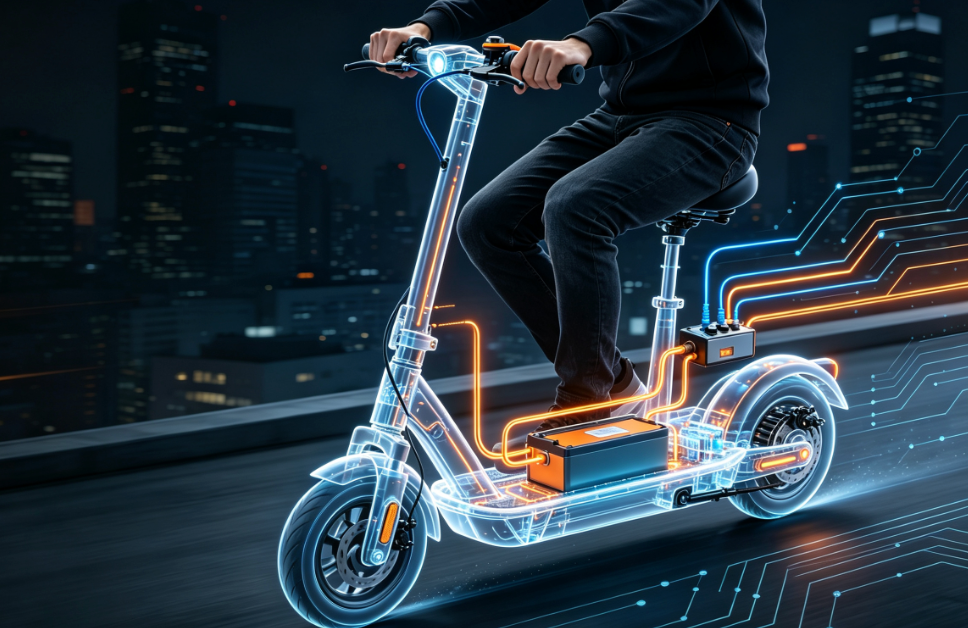
When you twist the throttle on an electric scooter, acceleration seems almost instantaneous. The scooter responds, the motor begins turning, and the wheels push the vehicle forward. For the rider, this entire process may feel like one simple action.
However, behind that quick response is a coordinated electrical and mechanical system involving the throttle, controller, battery, motor, and drivetrain.
Understanding what happens inside an electric scooter can make riding more interesting. More importantly, it can help riders understand why different scooters feel different, why certain components affect performance, and why proper maintenance matters.
1. It Starts With the Throttle
The entire process begins with a simple movement from the rider.
When you twist, press, or push the throttle, you are not directly supplying electricity to the motor. Instead, the throttle acts as an electronic input device that communicates your acceleration request to the scooter's control system.
Modern electric scooters commonly use electronic throttle sensors. One common technology is the Hall-effect sensor, which detects changes in a magnetic field and converts the rider's throttle movement into an electrical signal.
In other words, your hand movement becomes information.
A small throttle input can request gentle acceleration, while a larger input can request greater motor output. The scooter's electronics continuously monitor this input and respond accordingly.
This is why the throttle is better understood as a communication interface rather than a simple mechanical accelerator.
2. The Controller Receives the Signal
After the throttle creates a signal, that information travels to the electric scooter's controller.
The controller is one of the most important components in the entire power system. It acts as an electronic bridge between the rider, battery, and motor.

The battery stores electrical energy, while the motor needs electrical power delivered in a controlled way. The controller manages this relationship.
When it receives the throttle signal, the controller interprets what the rider wants and determines how the motor should respond.
This process takes place extremely quickly.
For the rider, there is usually no noticeable delay between moving the throttle and feeling the scooter accelerate.
The controller therefore plays a major role in creating the scooter's acceleration characteristics.
3. The Battery Supplies the Energy
Once the controller receives the acceleration request, the battery becomes the primary energy source.
An electric scooter battery stores electrical energy using rechargeable cells. When the scooter is switched on and the rider requests acceleration, this stored energy becomes available to the power system.
Battery specifications are often described using voltage and capacity.
Voltage represents electrical potential, while battery capacity describes how much electrical charge the battery can store. Energy capacity is commonly expressed in watt-hours.
However, the battery does more than determine how far the scooter can travel.
Its characteristics also influence how the electrical system can deliver power during acceleration.
The actual energy consumed during a ride depends on many factors, including rider weight, speed, terrain, wind, temperature, acceleration habits, and tire condition.
This is why the same scooter can achieve different real-world range results under different riding conditions.
4. The Controller Regulates Power to the Motor
The electrical energy from the battery does not simply flow uncontrolled into the motor.
The controller regulates the power supplied to the motor.
Many modern electric scooters use brushless DC motors. These motors rely on controlled electrical currents passing through different motor phases to create changing magnetic fields.
The controller manages this process.
By controlling when and how electrical current is delivered, it allows the motor to rotate in a controlled manner.
This is one of the most important jobs performed by the controller.
Without appropriate electronic control, the motor could not provide the smooth and predictable performance expected from a modern electric scooter.

5. The Motor Converts Electricity Into Motion
Now we reach the part that the rider can actually feel.
The motor converts electrical energy into mechanical energy.
Inside a brushless motor, electrical current creates magnetic fields. These magnetic fields interact with the motor's rotating components, causing the rotor to turn.
The rotational force produced by the motor is known as torque.
Torque is especially important during acceleration.
When the motor generates torque, it turns the scooter's powered wheel. The rotating wheel then interacts with the road surface, producing the force that moves the scooter forward.
The energy transformation can be simplified as:
Electrical Energy → Electromagnetic Force → Mechanical Rotation → Forward Movement
What the rider experiences as acceleration is therefore the final result of several stages of energy conversion.
6. Why Torque Matters
When discussing electric scooters, motor wattage is often the first specification people notice.
However, wattage does not tell the entire story.
Torque is the rotational force produced by the motor, and it plays an important role when the scooter starts moving or climbs a slope.
A scooter needs sufficient torque to overcome resistance and accelerate the combined weight of the scooter and rider.
This is why two scooters with similar motor power can sometimes feel different when riding.
Their battery systems, controllers, motor characteristics, wheel sizes, total weight, and software settings can all influence how power is delivered.
The motor is only one part of the overall system.
7. The Wheel Transfers Power to the Road
Once the motor starts rotating, the wheel becomes the final mechanical link between the scooter and the road.
Many electric scooters use hub motors, where the motor is integrated directly into the wheel.
This design eliminates the need for a traditional chain or belt between a separate motor and wheel.
As the motor turns, the wheel turns with it.
The tire then creates contact with the road surface.
The interaction between the tire and road allows the scooter to move forward.
This is why tire condition and traction matter. Even a powerful motor cannot deliver its full potential if the tire cannot effectively transfer force to the riding surface.

8. What Happens When You Go Uphill?
The process becomes more demanding when the scooter encounters a hill.
On flat ground, the motor primarily needs to overcome rolling resistance, aerodynamic drag, and the forces associated with acceleration.
When climbing, gravity creates additional resistance.
The motor therefore needs to produce more torque to maintain movement.
The electrical system may respond by drawing more power from the battery.
This is one reason climbing hills can reduce range compared with riding on flat roads.
Rider weight, slope angle, speed, wind, and riding style can all influence how much energy is required.
9. Why Higher Speeds Use More Energy
Speed also affects the energy required to move an electric scooter.
At higher speeds, aerodynamic drag becomes increasingly significant. The scooter must work harder to push through the air.
Acceleration also consumes energy. Repeatedly accelerating and slowing down can therefore use more battery power than maintaining a relatively consistent speed.
For riders who want to maximize range, smooth acceleration and moderate speeds can generally be more efficient than aggressive riding.
This demonstrates an important point: the rider is also part of the scooter's energy system.
What Happens When You Release the Throttle?
Now imagine that you stop accelerating.
When you release the throttle, the electronic signal changes.
The controller detects the change and reduces or stops power delivery to the motor, depending on the scooter's control configuration.
The scooter does not necessarily stop immediately.
Because it has momentum, it may continue moving forward.
Rolling resistance, air resistance, and the road surface gradually reduce its speed.
Some electric scooters may also provide electronic or regenerative braking when the rider releases the throttle, depending on the model and settings.
Mechanical brakes remain an important part of stopping control.
10. Where Does Regenerative Braking Fit In?
Regenerative braking is another interesting part of electric scooter technology.
In certain systems, the motor can operate as a generator during deceleration. Instead of using the motor only to produce forward movement, the system can convert some mechanical energy back into electrical energy.
That electrical energy can potentially be returned to the battery.
However, regenerative braking varies by model and should not be treated as a substitute for mechanical braking.
The actual braking behavior depends on the scooter's specific electrical and mechanical design.
11. Why Understanding the System Matters
You do not need to be an engineer to understand the basic operation of an electric scooter.
Knowing how the main components work together can make you a more informed rider.
For example, if a scooter suddenly fails to respond to the throttle, the issue may involve the throttle, wiring, controller, or another electrical component.
If acceleration changes unexpectedly, the controller or motor system may require inspection.
If range decreases significantly, battery condition, tire pressure, riding style, weather, and terrain may all be factors.
Understanding these relationships helps riders communicate more effectively when maintenance or professional service is required.
For safety reasons, complex electrical repairs, especially those involving high-energy batteries, should be handled according to the manufacturer's service guidance or by qualified technicians.
12. The Complete Journey
So, what actually happens when you twist the throttle?
The process can be summarized in one simple chain:
Rider → Throttle → Controller → Battery → Controller → Motor → Wheel → Road
The rider provides the command.
The throttle turns that movement into an electrical signal.
The controller interprets the signal.
The battery provides electrical energy.
The controller regulates that energy.
The motor converts electrical energy into rotational force.
The wheel transfers that force to the road.
The scooter accelerates.
All of this happens within a very short period of time.

An electric scooter may appear simple from the outside, but every acceleration involves a carefully coordinated interaction between electronics, battery technology, electromagnetism, mechanical components, and road traction.
The next time you twist the throttle, remember that you are not simply "turning on" the motor.
You are sending a command through an interconnected system designed to transform stored electrical energy into controlled mechanical movement.
That hidden process is what makes electric scooters more than just a motor and a battery. It is the combination of these technologies working together that creates the smooth, responsive riding experience we feel every time we accelerate.
Relate reading:
👉Click our official website to view more content.
👉KuKirin A1 (UK) Foldable Electric Scooter Review|800W Motor, 45KM Range, 45KM/H Max Speed
👉KuKirin M4 Max (EU) Electric Scooter Review