
When you ride an electric scooter, the experience can feel remarkably simple.
Twist the throttle, and the scooter moves.
Release it, and acceleration stops.
Press the brake, and the scooter slows down.
Behind these simple actions, however, is a complex electronic system working continuously in the background.
For a KuKirin electric scooter, the battery, controller, motor, throttle, display, wiring, and braking system all contribute to the riding experience.
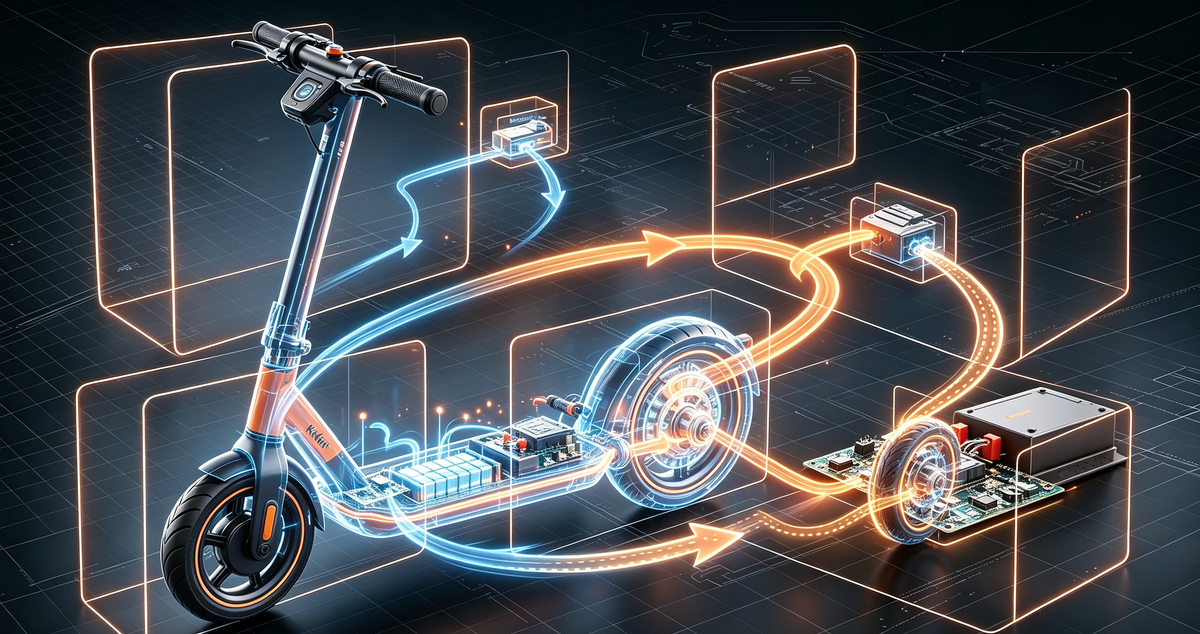
The basic energy path can be simplified as:
Battery → Controller → Motor → Wheel → Road
At the same time, the rider provides commands through the throttle and other controls.
Understanding this system makes it easier to understand what the numbers on an electric scooter specification sheet actually mean.
1. The Battery: Where the Energy Starts
The battery is the primary energy-storage component of an electric scooter.
Before the scooter moves, electrical energy is stored inside the battery pack.
When the rider requests acceleration, that stored energy becomes available to the drive system.
KuKirin offers scooters with different battery configurations for different performance requirements.
For example, the KuKirin G2 uses a 48V 15.6Ah battery, while the G2 Master uses a 52V 20.8Ah battery. The G4 uses a larger 60V 20Ah battery.
These numbers provide useful information about the electrical system, but they do not tell the entire story.
Battery capacity, motor output, controller characteristics, rider weight, terrain, speed, and riding style all influence real-world performance.
2. What Does Voltage Actually Do?
Voltage represents electrical potential.
You can think of it as part of the electrical pressure available to the system.
A 48V system and a 60V system operate at different electrical levels, and the motor and controller must be designed to work with the appropriate battery voltage.
This is why replacing a scooter battery with a different voltage is not simply a matter of installing a larger battery.
The battery, controller, motor, charger, and other electrical components must be compatible.
For KuKirin riders, this is especially important when considering replacement electrical components.
3. The Controller: The Electrical Coordinator
The battery stores the energy, but the controller manages how that energy is used.
When the rider twists the throttle, the throttle sends a signal to the controller.
The controller interprets that signal and manages the electrical power delivered to the motor.
This creates a basic communication chain:
Rider → Throttle → Controller → Motor
At the same time, the controller is connected to the battery:
Battery → Controller → Motor
The controller therefore sits at the center of the propulsion system.

4. The Motor Converts Electricity Into Rotation
The motor is where electrical energy becomes mechanical movement.
Electrical power from the battery is managed by the controller and delivered to the motor.
Inside the motor, electromagnetic forces create rotational movement.
That rotation eventually turns the wheel.
KuKirin's range demonstrates how different electrical configurations can support different scooter designs. The official range currently includes single-motor models such as the G2 and G4 as well as dual-motor models such as the G2 Master and G2 Ultra.
A motor's wattage is useful information, but actual performance depends on the complete system.
5. From Motor Rotation to Wheel Movement
Once the motor produces rotational force, that force reaches the wheel.
The tire then transfers the available force to the road surface.
This final step is extremely important.
A motor can produce rotational force, but the tire still needs sufficient traction to convert that force into forward movement.
Road surface, tire condition, rider weight, and weather can all influence traction.

This is why an electric scooter should be viewed as an integrated system rather than a collection of individual specifications.
6. What Happens When You Twist the Throttle?
Let's follow one complete throttle action.
First, the rider twists the throttle.
The throttle sensor detects the change.
An electrical signal travels to the controller.
The controller interprets the request.
The battery supplies electrical energy.
The controller regulates that energy.
The motor receives controlled electrical power.
The motor creates rotational force.
The wheel turns.
The tire interacts with the road.
The scooter moves forward.
All of this happens extremely quickly.

7. Why the Electrical System Matters
A scooter's riding characteristics are not determined by the motor alone.

Its official specifications list an 800W motor, 48V 15.6Ah battery, 45 km/h maximum speed, and 55 km maximum range.
These specifications work together as a system.
The battery provides energy.
The controller manages power.
The motor converts that energy into movement.
The tires transfer movement to the road.
This is why looking at a single number can provide only a limited understanding of scooter performance.
8. Single-Motor and Dual-Motor Electronics
KuKirin also offers dual-motor configurations.
For example, the G2 Master uses two 1000W motors and a 52V 20.8Ah battery, while the G2 Ultra uses two 800W motors with a 48V 18Ah battery.

With a dual-motor system, electronic control becomes more involved because the system manages power for two motors rather than one.
The additional motor can change how the scooter delivers traction and acceleration, particularly under demanding riding conditions.
However, dual-motor performance also depends on battery capacity, controller design, total scooter weight, and riding conditions.
9. Why the Complete System Matters
When choosing an electric scooter, it is useful to look beyond individual specifications.
Consider:
- Battery voltage
- Battery capacity
- Motor configuration
- Controller
- Tire design
- Braking system
- Scooter weight
- Intended riding environment
These components interact continuously.
The result is the riding experience you feel through the handlebars and deck.
Electric scooter electronics may be hidden beneath the deck, inside the frame, or within the motor assembly, but they are responsible for nearly every part of the riding experience.
The battery stores the energy.
The controller manages it.
The motor converts it into rotation.
The wheel transfers that rotation to the road.
For KuKirin scooters, understanding this chain can help riders make better sense of specifications and better understand what happens every time they twist the throttle.
Battery → Controller → Motor → Wheel → Road.
Related reading:
👉 Visit our official KuKirin Onlinestore to explore more details.
👉What Happens Inside an Electric Scooter When You Twist the Throttle?
👉KuKirin G2 (2026 New): The Smart Touchscreen Commuter for Modern Streets